




To proactively respond to the profound impact of intelligent technologies on higher education and business education, promote innovation and reform in business courses, and enhance faculty members' digital and intelligent teaching capabilities, Surrey International Institute held a special teaching training session on the morning of July 3, 2026. The training, themed The Logic and Practical Pathways of Business Course Innovation in the Agent Era—From Knowledge Delivery to Project-Driven, AI-Enabled Collaborative Learning and Competency Development, was led by Associate Professor Liu Zhuang, recipient of the Ministry of Education's AI + Higher Education Exemplary Case Award, one of the Top Ten Outstanding Teachers in National University Financial Experiment Teaching, and winner of the Liaoning Provincial Grand Prize in the Teaching Innovation Competition. All Chinese faculty members of the institute participated in the training.
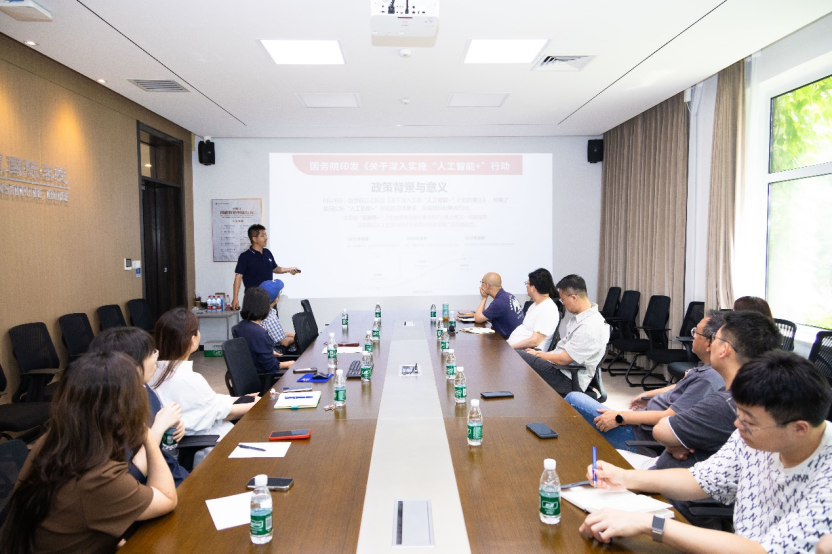
During the training session, drawing upon his extensive practical experience in large language model and intelligent agent technology application, course development, classroom teaching, and teaching innovation competitions, Associate Professor Liu Zhuang delivered an excellent presentation that combined both theoretical depth and practical guidance. The training content closely centered on the core issues of business course reform in the agent era. Starting from the profound impact of current large language models and intelligent agent technologies on the finance and business industries as well as higher education teaching, he systematically elaborated on the internal logic and implementation pathways for the transformation of business courses from traditional knowledge delivery to project-driven approaches, task-chain design, AI-enabled collaborative learning, and competency development. He focused on analyzing the basic logical framework for course reform, innovative strategies for classroom organization, effective methods for course project design, and actionable pathways and tools for faculty members to undertake course innovation. Furthermore, in light of the institute's disciplinary characteristics, he delved into how to build a course system integrating professional knowledge + data competency + AI collaboration + business decision-making, providing clear ideas and feasible solutions for the institute to advance course development innovation, deepen disciplinary construction, and improve talent cultivation quality. The entire lecture was closely aligned with the institute's actual needs, with solid content and clear pathways, offering a reference that was both forward-looking and actionable for course reform.
Throughout the training, participating faculty members listened attentively and thought actively. They engaged in in-depth discussions with Associate Professor Liu on practical issues they encountered in course design, classroom teaching, the specific implementation of AI-enabled collaborative teaching models, and the use of large language model tools. Associate Professor Liu provided professional and clear answers to every question, with practical and feasible suggestions. The participating teachers expressed that they had benefited greatly.
This special training is an important initiative by the institute to deepen education and teaching reform and advance the construction of a digital and intelligent course system. Through the training, faculty members have gained a more systematic and profound understanding of the direction and pathways for business course reform in the Agent era, effectively enhancing their awareness and capabilities in advancing teaching innovation through project-driven approaches and AI collaboration. Going forward, the institute will take this training as a new starting point, continuously improve the faculty development support system, build more high-level learning and exchange platforms, promote the iterative upgrading of faculty teaching capabilities, and inject sustained momentum into the high-quality development of the institute's education and teaching work.